
Start with the pattern, not a shopping list
A nose that is always blocked, itchy or running can wear you down. Allergic rhinitis can disrupt sleep and concentration as well as cause sneezing and watery eyes. It is not something you simply have to put up with.1, 2
Hay fever is allergic rhinitis triggered by pollen. Symptoms at other times of year may be linked to house-dust mites, animals or mould. Not every runny or blocked nose is allergic: infections and non-allergic inflammation can feel similar.1, 3
Before changing your home, notice when and where symptoms appear. Are they seasonal, worse on waking, associated with a pet, or better away from work? Keep a brief note of the setting, symptoms and effect on sleep. These patterns are clues, not a diagnosis. Symptoms linked to the workplace deserve discussion with a clinician.3, 4
01 / Everyday exposure
Pollen: build a simple coming-home routine
The aim is to reduce exposure without making the whole season revolve around hay fever. Check the pollen forecast and adapt longer outdoor activities when levels are high.4, 6
Before and during time outdoors
Wraparound sunglasses and a wide-brimmed hat help shield the eyes and face; a well-fitting mask may help during unavoidable exposure. Avoid mowing the lawn yourself when grass pollen triggers your symptoms. Keep car windows closed, use an effective pollen filter and consider recirculating the cabin air during high exposure.4, 6
When you get home
After substantial outdoor exposure, change your clothes and shower, including washing your hair. Avoid putting outdoor clothing on the bed. On high-pollen days, do not dry bedding or clothes outdoors, where they can collect pollen.4, 6
Pets can also bring pollen indoors on their coats, even when the animal itself is not your allergy trigger. Allergy UK suggests wiping their fur with a damp microfibre cloth after they have been outside.4

Keep bedroom windows closed when pollen exposure is high, but do not ignore ventilation or condensation. Use kitchen and bathroom extraction; when drying laundry indoors, use a well-ventilated space or a suitable dryer rather than letting moisture build up.6, 7
Take extra care around thunderstorms when pollen levels are high. Stay indoors just before, during and after the storm where possible, particularly if you also have asthma. Follow your asthma action plan and seek medical help for new wheeze, chest tightness or breathing difficulty.8
02 / A more comfortable bedroom
House-dust mites: start with the bedroom
Dust mites occur in ordinary homes, including clean ones. For people allergic to them, symptoms may be worse overnight or when bedding is disturbed. Their presence is not a judgement on your housekeeping.5
Wash bed linen weekly at 60°C where the fabric permits. Damp-dust surfaces, use an effective high-filtration vacuum, and keep soft toys manageable and washable. If someone else can do the dustiest tasks without symptoms, sharing those jobs may help.5
For a favourite soft toy that cannot tolerate a 60°C wash, Allergy UK suggests freezing it in a sealed bag for at least 12 hours, then washing at the recommended temperature. Freezing alone does not remove the allergen; the wash afterwards matters.5
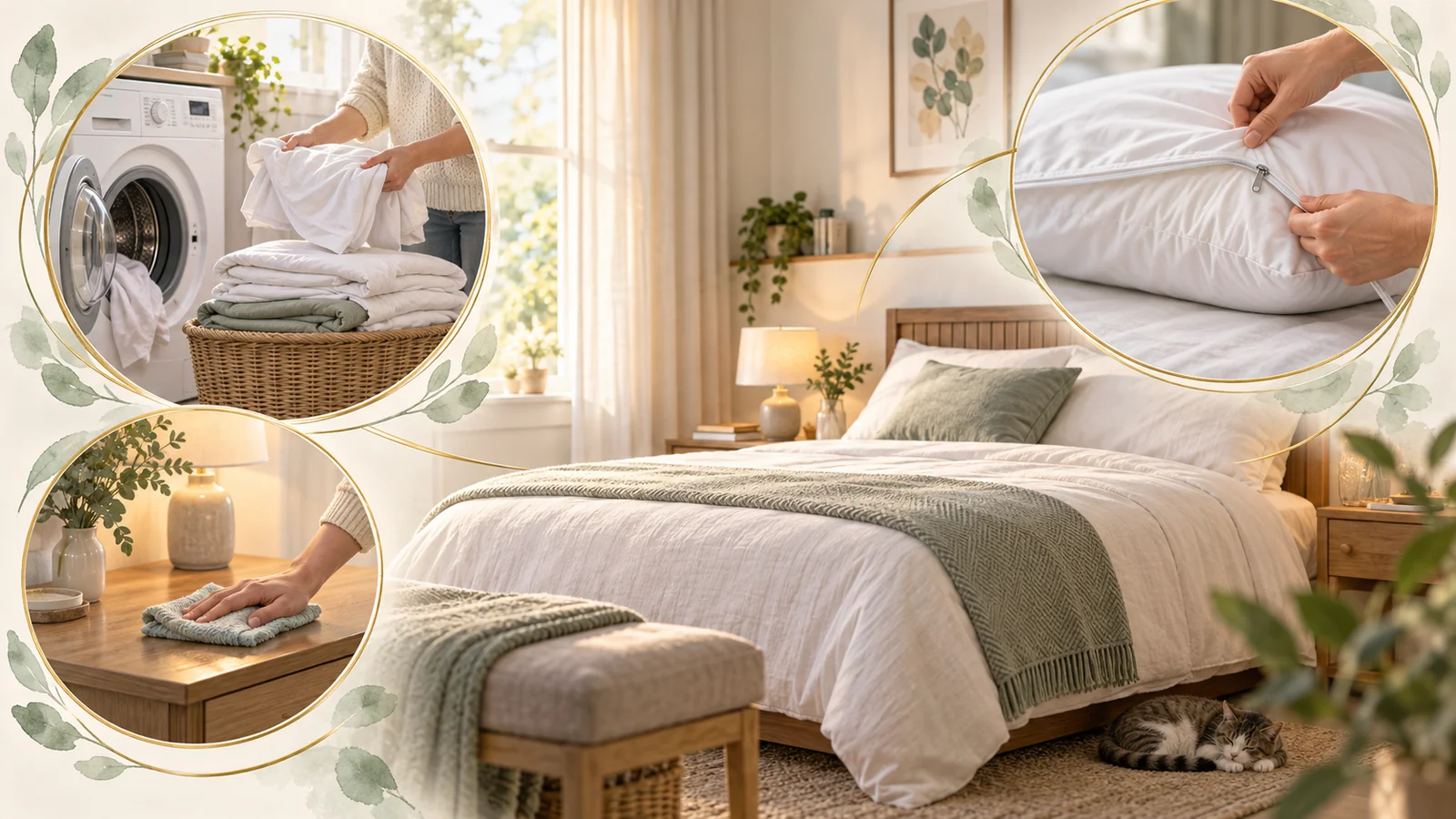
Allergen-resistant mattress and pillow covers can be considered as part of a wider approach, but covers alone have not shown reliable symptom benefit. Studies of broader dust-mite avoidance measures are limited. Start with affordable changes rather than assuming you need new flooring, bedding and furniture.5, 9
03 / The indoor environment
Pets, damp and indoor irritants
Pets: target a relevant allergy
Pet allergy is caused by animal proteins, not simply visible hair. When a pet is a likely trigger, keep it out of the bedroom, wash hands after contact and clean pet bedding and affected soft furnishings. A short-haired or “hypoallergenic” breed is not a guarantee against symptoms.10
You do not need to make a major decision about a much-loved pet on the basis of a guess. Discuss the pattern and whether testing would help first.3, 10

Damp: deal with the source of moisture
Address leaks, persistent condensation and inadequate extraction rather than repeatedly wiping the same patch of mould. Use bathroom and kitchen fans and avoid leaving wet clothes to dry in unventilated rooms. Persistent or extensive damp may need help from the property owner or an appropriate professional.7
For dust-mite control, Allergy UK advises keeping relative humidity between 30% and 50%. A small humidity meter can help assess persistent damp. Prioritise leaks and ventilation; consider a dehumidifier only if humidity remains high, not as an essential purchase for every person with rhinitis. Avoid making rooms excessively dry.5, 7
A humidifier is not a default allergy treatment: extra humidity can favour dust mites and mould. Smoke and some fragranced sprays or cleaning products can also aggravate nasal symptoms without being the underlying allergen. Reduce products that clearly bother you.3, 7
04 / Practical nasal care
Saline nasal care: an option worth considering
Saline is salt water prepared at a suitable concentration for the nose. A rinse can wash away mucus and allergens and may improve symptoms. Research is encouraging but uncertain; it has not established that saline is equivalent to a steroid nasal spray or that adding it always provides extra benefit.11, 12
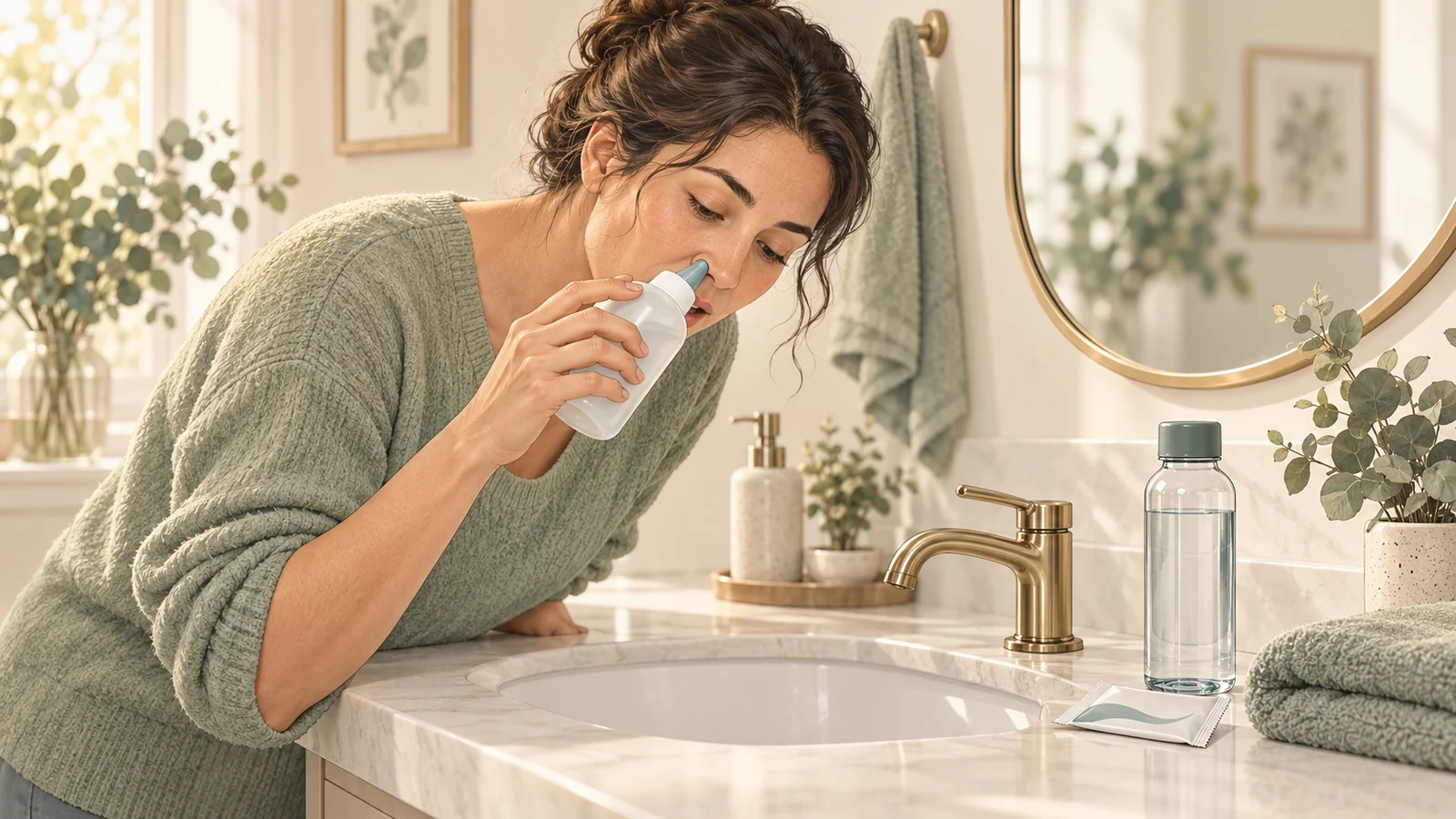
A ready-made saline product, or a purpose-made rinse device with the correct sachets, can make preparation more straightforward. A fine-mist spray is not the same as a larger-volume rinse. Ask a pharmacist which approach suits you.12
Important / Water safety
Safe to drink does not mean safe to rinse with.Use sterile or distilled water suitable for this purpose, or water that has been boiled and allowed to cool. Do not use untreated tap water directly. Ordinary bottled drinking water is not automatically sterile. Follow recognised safe-water guidance and the device instructions.13
Wash your hands, prepare the correct saline mixture rather than using plain water, lean over a sink and rinse gently as directed. Clean and dry the device after use. Do not force the rinse; stop and seek advice if it causes pain or bleeding, or makes symptoms worse.12
Seek advice before irrigation if your immune system is impaired. Children need an age-appropriate product and adult supervision, and should not be forced to rinse. When using both saline and a medicated spray, rinse first so you do not wash the medicine away afterwards.12, 14
05 / Barrier and moisture care
Barrier balms: around, not deep inside
A thin smear of petroleum jelly, such as Vaseline, around the outside rim of the nostrils is suggested by the NHS to help trap pollen. Allergy UK also suggests nasal barrier balms around the nostrils. Treat this as an optional extra, not a replacement for effective treatment. Do not fill the nostrils or push balm deep inside.4, 6
What about after rinsing?
Use any saline rinse first, then your medicated spray as instructed. For people choosing a barrier balm, applying it after washing or rinsing, once the outside skin is dry, is a practical way to fit it into the routine. Reapply only a thin external layer if it has been wiped away. There is no need to coat the nasal passages with Vaseline after each rinse.4, 6, 14
Consider a saline mist or ask a pharmacist about a suitable water-soluble nasal moisturiser, used sparingly as instructed. Avoid making petroleum jelly deep inside the nose a long-term or bedtime habit: rarely, oily material can reach the lungs and cause inflammation. Follow any specific short-course ointment instructions given by your clinician.15
06 / Comfort for itchy eyes
Do not forget itchy, watery eyes
Rest a clean, cool flannel over closed eyes for a few minutes and avoid rubbing them. Artificial-tear drops may help; ask a pharmacist for a suitable eye product and follow its instructions. Do not put nasal-rinse mixtures into your eyes. Leave contact lenses out until your eyes have settled.16, 17
Eye pain, sensitivity to light or changes in vision need urgent assessment through an urgent GP appointment or NHS 111, rather than simply more allergy treatment.17
07 / Keep it proportionate
Before you spend money
There is a difference between a sensible additional measure and an essential purchase.
Air purifiers
Air filtration may give a small improvement in nasal symptoms, but benefits are not guaranteed. A 2024 review found small improvements in symptom scores without clear pooled benefits for medication use or quality of life. Consider it optional, not a substitute for tackling the source of exposure or using effective treatment.18
Local honey and supplements
Evidence for honey and many marketed supplements is inconsistent or too limited to recommend them as established rhinitis treatments. “Natural” does not mean free from side effects or interactions.19
Steam and restrictive diets
Avoid leaning over bowls of hot water: steam inhalation can cause serious scalds, especially in children, without strong evidence of benefit. Do not routinely cut out dairy or gluten for nasal allergy; food is rarely the cause of allergic rhinitis. Discuss suspected food reactions separately.3, 20
08 / Make treatment work properly
Home-first does not have to mean medicine-free
Home measures and medicines can work alongside one another. Antihistamines are useful for sneezing, itching and a runny nose; a pharmacist can advise on less-sedating options. Nasal steroid sprays reduce inflammation and are particularly useful for persistent or troublesome symptoms, including blockage.2, 6
Steroid sprays usually need regular use and time to work, not just an occasional spray on the worst days. For predictable seasonal symptoms, discuss starting preventive treatment before your usual season. Check suitability during pregnancy or breastfeeding, for children, and alongside other medicines.2, 21
Persistent symptoms may call for a different treatment plan rather than more household changes. The ARIA–EAACI guidelines include combined antihistamine–steroid nasal sprays as an option, chosen with a clinician according to symptom burden, preferences and cost.22
Technique matters
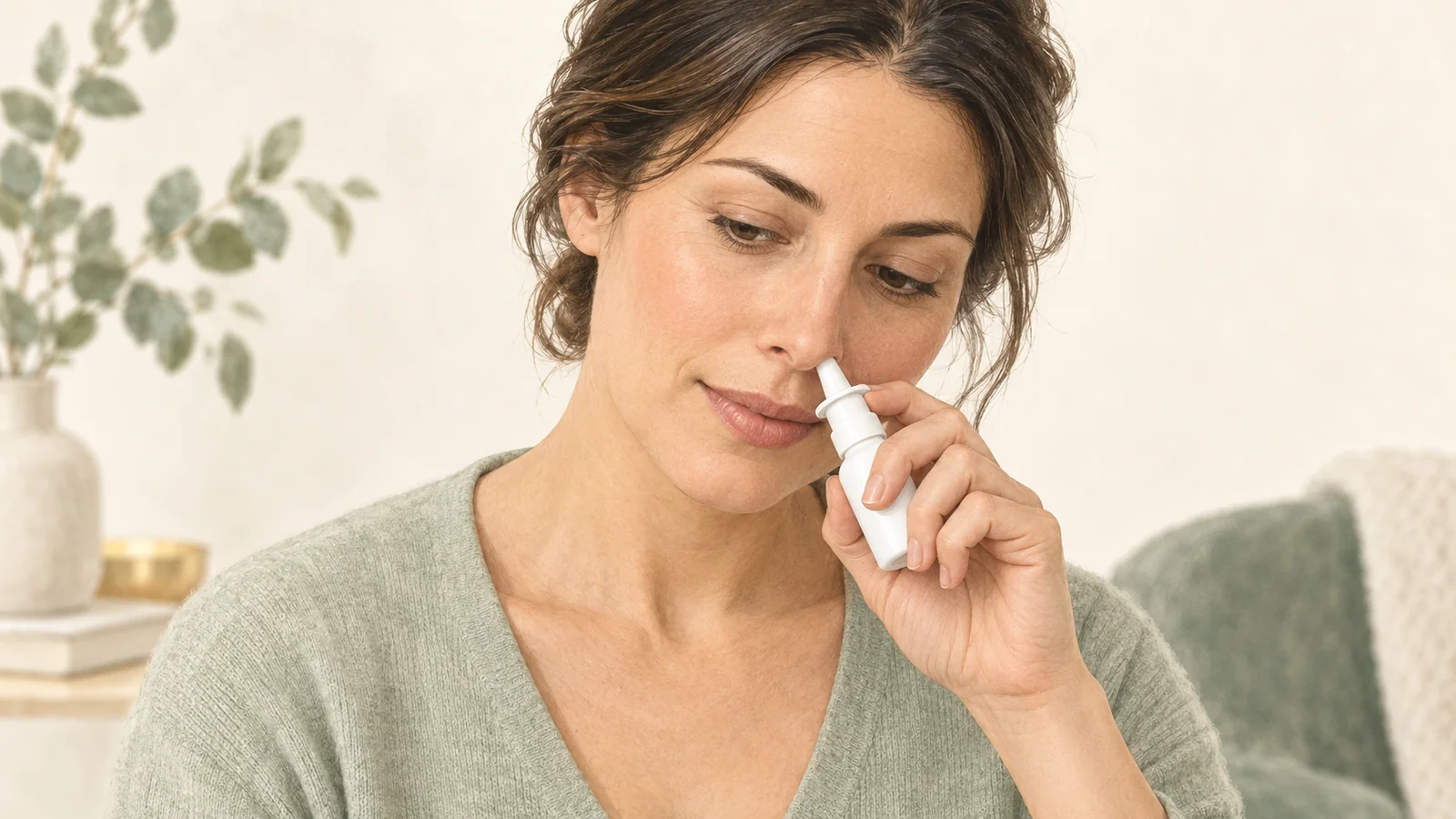
- Gently clear your nose; if using a saline rinse, use it first. Shake and prime the spray as its instructions require.
- Keep your head slightly forward. Use the opposite hand: right hand for the left nostril, and vice versa.
- Place the tip just inside. Aim gently outwards, away from the central dividing wall of the nose, rather than towards it.
- Breathe in gently as you spray. Avoid a hard sniff, then wipe the nozzle and replace the cap.
Technique guidance: BSACI.14
Sprays containing xylometazoline or oxymetazoline should not be used for more than five days under the MHRA’s April 2026 advice, even if an older pack still says seven. Longer use can cause rebound congestion. This is not a five-day limit on saline or steroid sprays. Seek advice if you are struggling to stop a decongestant.23
A note for parents
Allergic rhinitis can affect sleep and school concentration. Ongoing mouth breathing, snoring or a child who seems to “always have a cold” deserves review rather than assumption. These symptoms can have other causes too.1, 2
Keep routines simple: clothing changes after pollen exposure, suitable bedroom care and age-appropriate nasal treatment. Ask a pharmacist or clinician which products and doses are suitable; do not simply use an adult product or dose. Saline irrigation needs an approach the child can safely tolerate.2, 12
When home measures are not enough
Arrange a GP review when symptoms disturb sleep, school, work or everyday life; the cause is uncertain; or pharmacy treatment is not helping. Do not wait through an entire pollen season when symptoms remain troublesome. New wheeze, chest tightness or worsening asthma also needs medical advice.1, 2
Persistent one-sided blockage, repeated blood-stained discharge or bleeding, and significant nasal or facial pain should not simply be labelled hay fever. Facial swelling needs prompt medical assessment.21, 24
Call 999 if someone is gasping, choking or unable to speak normally because of breathlessness. Do not treat this as an ordinary blocked nose.25
A clinician may check the diagnosis, examine the nose and review treatment technique. Allergy testing is helpful in selected situations, not automatically for everyone. Specialist treatments, including allergen immunotherapy, may be considered when confirmed allergy remains severe despite appropriate treatment.2, 4
Put it into practice
Your starting plan
Notice the pattern
Write down the main symptoms, likely exposures and effect on sleep. Choose a small number of relevant changes.
Keep the routine simple
Adapt pollen exposure when needed, use any nasal treatment correctly, and follow the safe-water rules for rinsing.
Review what helps
Keep up relevant bedding and cleaning routines. Seek advice when symptoms remain troublesome rather than adding more products.
The goal is not a perfect home. It is better-controlled symptoms with a routine you can live with.1, 3, 5
Common questions
Do I need allergy tests before making changes?
Not always. A clear seasonal pattern may be enough to guide initial care. Testing is more useful when the trigger is uncertain, a major avoidance decision is being considered, or immunotherapy is being discussed.4
Can I use saline and a steroid nasal spray together?
They may be used together when appropriate. Use the saline rinse first, then the medicated spray as instructed. Saline is not a reason to stop prescribed treatment.11, 14
Should I put Vaseline in my nose after rinsing?
Not as a routine coating inside the nose. An optional thin barrier around the nostril rims is different from repeated deep application. For internal dryness, ask about saline mist or a suitable water-soluble nasal moisturiser.6, 15
Should everyone with hay fever buy an air purifier?
No. Some people may find filtration helpful, but average symptom benefits are small and it is not an essential first purchase. Begin with the measures most relevant to your exposure.18
Evidence and further reading
Sources
Sources checked on 14 September 2026. Numbered links connect the advice to guidance and research. Practical exposure measures are not a promise of symptom relief; the evidence limitations are explained above.
- Allergic rhinitisNHS
- Allergic rhinitis (patient leaflet)BSACI
- Rhinitis: Expert Allergy GuideBSACI
- Allergic Rhinitis and Hay FeverAllergy UK
- House Dust Mite AllergyAllergy UK
- Hay feverNHS
- Indoor Air QualityAllergy UK
- Thunderstorm AsthmaAustralasian Society of Clinical Immunology and Allergy (ASCIA)
- House dust mite avoidance measures for perennial allergic rhinitisCochrane
- Pet AllergyAllergy UK
- Nasal saline for allergic rhinitisCochrane
- Is Rinsing Your Sinuses With Neti Pots Safe?FDA
- How to Safely Rinse SinusesCDC
- How to use a nasal spray (patient leaflet)BSACI
- Petroleum jelly: Safe for a dry nose?Mayo Clinic
- Allergic Eye DiseaseAllergy UK
- ConjunctivitisNHS
- Effectiveness of Air Filters in Allergic Rhinitis: A Systematic Review and Meta-AnalysisShih and colleagues, Indoor Air (2024)
- Seasonal Allergies at a GlanceUS National Center for Complementary and Integrative Health
- Public safety warning: steam inhalation causes burnsRoyal Devon NHS / British Burn Association
- Allergic Rhinoconjunctivitis Treatment Pathway (adults)Nottinghamshire Area Prescribing Committee
- ARIA–EAACI Guidelines—2024–2025 Revision: Part I—Guidelines on Intranasal TreatmentsSousa-Pinto and colleagues, Allergy / ARIA–EAACI
- Recommended use of some nasal decongestant sprays limited to five daysMHRA
- Allergic rhinitis: ManagementNICE Clinical Knowledge Summaries
- Shortness of breathNHS