
The starting point
Why rib cartilage may be part of your operation
Being told that rib cartilage may be used in your nose can sound surprising. I use it in selected first-time and revision rhinoplasty operations. In my practice, I most often use donated irradiated rib cartilage. This guide focuses on that option, with a separate explanation of harvesting your own rib.
When the rib graft comes from a donor, your own rib cartilage does not need to be harvested. There is no chest incision or chest harvest scar for that graft. This avoids a second surgical wound, but it does not remove the need for careful recovery from the nasal operation. [1]
Cartilage is firm, flexible supporting tissue. Along with bone and the overlying skin, it contributes to the nose’s shape. A graft is an additional piece used within the reconstruction; it may help provide support rather than simply add size. [2]
Use this article to prepare questions for your consultation and to refresh your understanding afterwards. Your agreed surgical plan and written discharge instructions take priority over general advice here.
Understanding the material
What is donated irradiated rib cartilage?
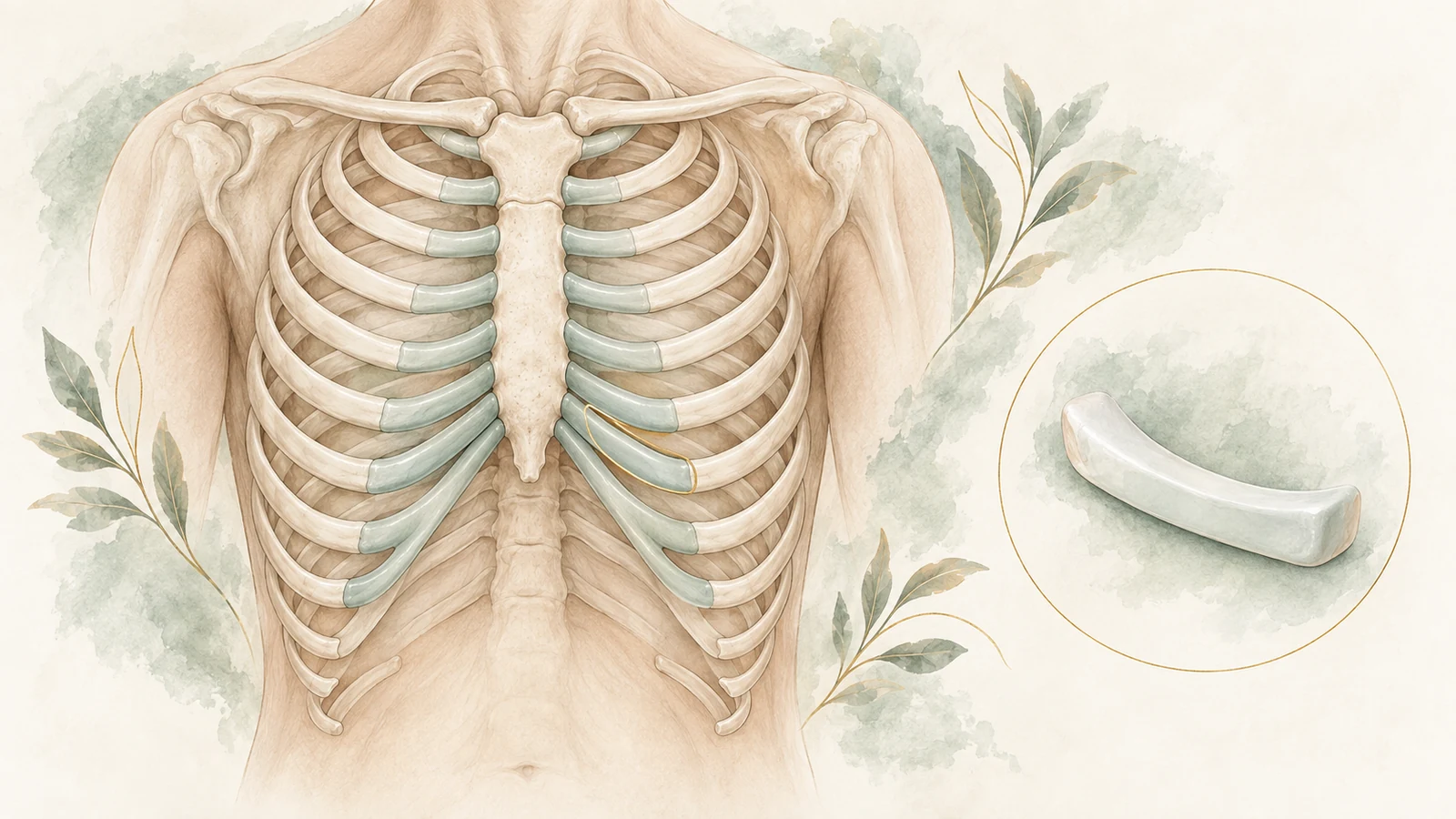
Donated cartilage is human tissue, not a synthetic plastic implant. It comes from a deceased donor through a tissue-donation and processing system. Cartilage is one of several musculoskeletal tissues that can be donated to help another person. [3]
You may see the terms allograft, homologous cartilage or irradiated homologous costal cartilage (IHCC). In this context, they describe donor rib cartilage; “costal” means relating to the ribs. The surgeon shapes the material into grafts appropriate to the reconstruction. [4]
What does “irradiated” mean?
The tissue is exposed to controlled radiation during processing to inactivate microorganisms. This happens before it is supplied for surgery. It does not mean you receive radiotherapy, and gamma irradiation does not make the graft radioactive. No radioactive source is implanted in your nose. [5]
How is donated tissue checked?
Donor assessment, testing, processing controls and records all matter. UK Human Tissue Authority standards address donor selection and testing, quality systems and traceability from donor to recipient. Traceability means a graft can be linked back to its donation and processing records while donor confidentiality is protected. [6]
These safeguards should not be described as a promise of zero transmission risk. Ask which tissue product is planned, how it is screened and processed, and what residual risks are included in your consent discussion. The precise tissue bank and preparation should be identified for your operation, rather than assumed from the words “donor rib”. [6]
Is this the same as fresh-frozen donor cartilage?
Not necessarily. Irradiated donor cartilage and fresh-frozen donor cartilage are different preparation categories. Processing varies between products, and evidence about one preparation should not automatically be applied to another. This article is centred on irradiated cartilage because that is the type I use most often. [7]
Primary and revision surgery
Why might rib cartilage be useful?
In a primary rhinoplasty, meaning a first operation, the planned changes may require more suitable supporting material than is available within the nose. A substantial reconstruction can be needed even when there has been no previous surgery.
In a revision rhinoplasty, cartilage may already have been removed or used for grafts, and the existing framework may need rebuilding. Rib cartilage can provide material when the amount or quality of remaining nasal cartilage is insufficient. [7]
Depending on the problem, grafts can be used around the bridge, tip-supporting framework or nasal sidewalls. The aim may be to support shape, help a structural breathing problem, or both. These are different tasks: the same graft is not suitable for every location or every patient. [4]
The useful consultation question is not just “Will you use rib?”, but “What will each graft do in my nose?” Ask to see the area that needs support and how the proposed change relates to your priorities. Needing a graft should not be treated as a judgement about you or, by itself, about a previous surgeon.
Choosing the source
Why not use cartilage from my nose or ear?
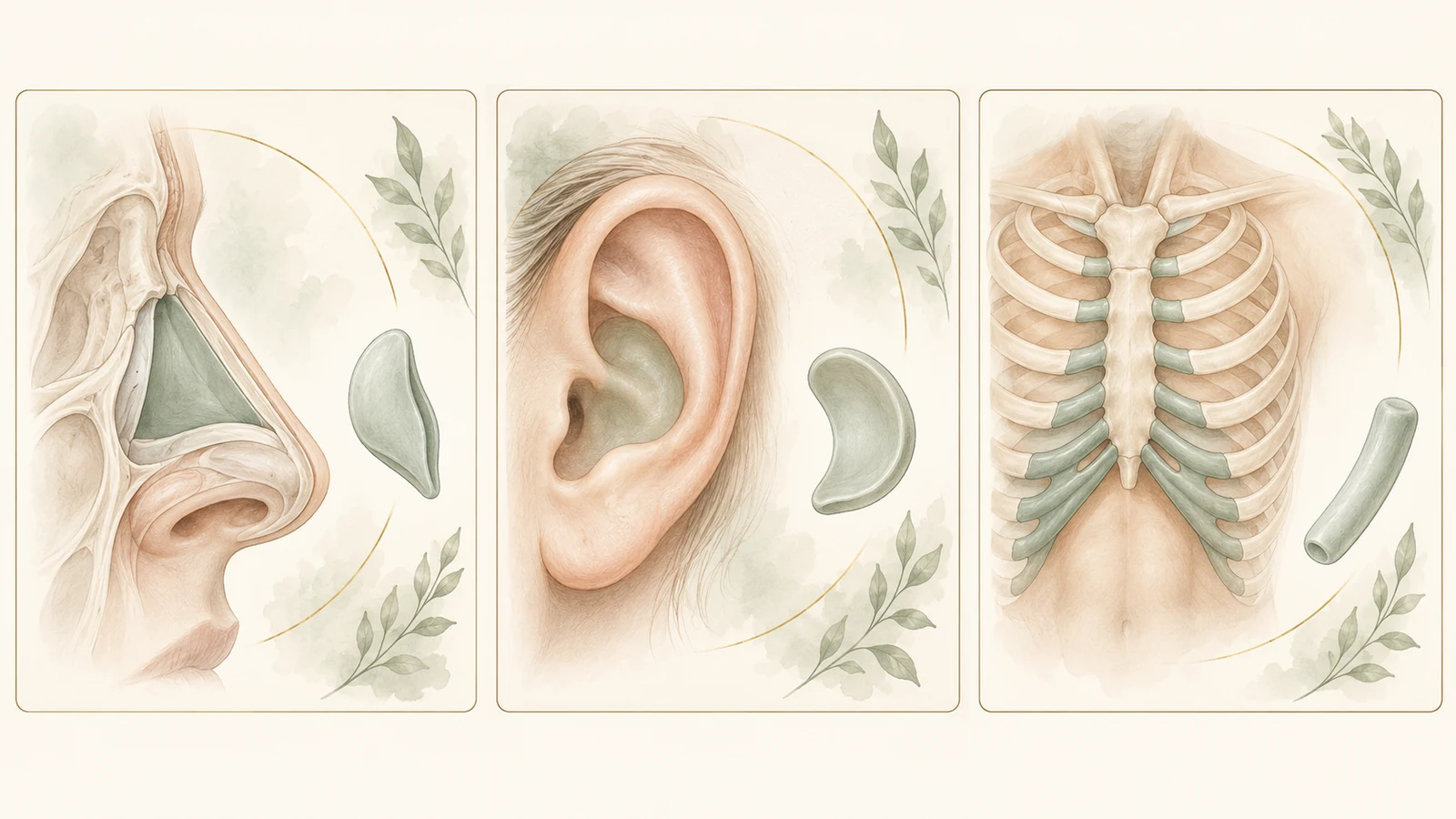
Septal cartilage comes from the central partition inside the nose. It can be useful when enough suitable material is available. Ear cartilage is another option, with a different natural shape and quantity. Own-rib cartilage provides a further source but requires a chest harvest. The choice depends on the amount, shape and support needed, as well as what is available. [2, 8]
Using donated rib avoids harvesting that rib graft from your chest. It does not necessarily mean that no other cartilage or tissue will be used: confirm the complete plan, including any separate ear or other donor site. It is also reasonable to ask why a less extensive reconstruction, a different graft source, or no surgery would or would not suit your goals.
Tell me before surgery if receiving donated human tissue raises personal, cultural or religious concerns. We should discuss acceptable alternatives and any limitations they introduce. Consent is a conversation, not simply a form to sign.
Benefits and uncertainties
How reliable is irradiated donor cartilage?
The principal practical advantage is avoiding a chest harvest. A comparative study also found shorter operating times with irradiated donor cartilage, although this does not predict the duration of an individual operation. [1]
Research supports IHCC as an option, but there is no single published percentage that can predict your outcome. Studies differ in the operations performed, graft locations, follow-up and definitions of complications. Reviews focused on building up the bridge cannot answer every question about tip support or complex reconstruction. [9]
A 2022 review included 1,017 patients and 1,956 irradiated grafts and reported low pooled rates of several graft complications. Much of the analysis counted grafts, not simply patients, and the evidence was mostly retrospective. Its figures should not be presented as a universal “chance of a problem”. [4]
A 2025 review of bridge augmentation found both own-rib and irradiated cartilage to be viable options, but most included studies were uncontrolled case series. Different pooled estimates across reviews underline the uncertainty rather than prove that either material is best for everyone. [9]
In a 2024 comparison involving 143 patients, revision surgery occurred in about 15% of each group. Infection rates were also not significantly different. Follow-up was shorter in the donor-cartilage group. These were overall revision outcomes, not simply cartilage rejection rates, and they are not my practice’s results or a prediction for you. [1]
Which graft-related problems should I understand?
Warping means bending or changing shape. Resorption means losing some graft volume. Other possible problems include infection, movement, a visible or palpable edge, and exposure of the graft. Some problems can require further treatment or surgery. [4]
The operation also carries broader rhinoplasty risks, including bleeding, persistent obstruction, asymmetry, scarring and an outcome that does not meet expectations. Choosing donor cartilage does not remove these risks. [10]
Ask which risks matter most in your case, how they would be recognised, and what the options would be if the graft or overall result needed attention.
Before your operation
Preparing for surgery and informed consent
Bring an up-to-date list of prescribed medicines, over-the-counter treatments and supplements, and discuss smoking and any previous healing problems. Do not stop prescribed medicines on your own: agree any changes with the surgical and prescribing teams. Let the team know about a new illness before surgery. [10]
Before the operation, make sure you can answer three questions:
- What is planned? Which tissue source, what the grafts are intended to do, and whether any separate harvest might be needed.
- What should I expect? The intended change, limitations, significant risks, and arrangements if further treatment becomes necessary.
- Who will help afterwards? Your transport and support arrangements, follow-up appointment, written care instructions and urgent contact route.
Keep a copy of the plan with your postoperative information. Questions about donor tissue are welcome; raise them before the day of surgery so there is time to consider the answers.
What happens during the operation?
Rhinoplasty is generally performed under a general anaesthetic. Access may be through incisions inside the nose or an open approach that includes a small incision between the nostrils. Splints or internal dressings may be used. The exact approach depends on the reconstruction. [2]
Using donated cartilage changes the source of the graft material; it does not turn a complex nasal reconstruction into a minor procedure.
After your operation
Recovery after donated rib cartilage grafting

You do not need chest-harvest aftercare when no cartilage has been taken from your chest. Follow the nasal-care instructions and any instructions for other procedures performed at the same time.
What can be expected early on?
A blocked nose, bruising, swelling and some blood-stained watery discharge can occur after septorhinoplasty. Internal dressings or splints may also obstruct breathing temporarily. These expected changes should be distinguished from increasing pain, worsening blockage or offensive discharge. [11]
Looking after your nose
Keep your head raised when resting and protect the nose from pressure and knocks. Follow instructions for keeping the external splint dry. Do not start manipulating, massaging or taping the nose unless your surgeon has specifically advised it. [12]
Avoid nose blowing until the team says it is safe; sneeze with your mouth open. Use only the cleaning, ointment, saline or spray regimen specified for your operation. An everyday allergy-care routine is not automatically suitable immediately after reconstructive surgery. [11]
Take prescribed medicines as directed. Ask before adding products to the wound or inside the nose, and attend the planned review rather than removing splints or sutures yourself.
Work, exercise and everyday activities
General rhinoplasty guidance suggests planning around two weeks away from work and roughly four to six weeks before strenuous exercise. These are planning ranges, not automatic clearance. Physical work, contact sport and activities that risk a knock to the nose may require longer restrictions. [12]
Ask specifically about lifting children, the gym, glasses, driving and travel. A calendar date alone does not tell the team whether you are ready for each activity. Not having a chest wound does not mean the nasal framework has healed sooner.
When will the final result be visible?
The nose may feel stiff or numb while healing, and the final appearance can take 12–18 months to emerge. Some stiffness can persist. Do not interpret a reassuring long-term timeline as advice to ignore a new or worsening problem. [10]
Keep this section handy
When to seek medical help
Contact your surgeon or operating hospital promptly the same day for increasing redness, swelling or pain; a fever or feeling unwell; a nose becoming progressively more blocked and sore; or smelly discharge. Pain that is not controlled by your prescribed treatment also needs advice. [2, 11]
Report persistent fresh bleeding, a wound opening or visible graft material without waiting for the next routine appointment. Use the contact details on your discharge paperwork. Do not rely on a routine website enquiry for an urgent postoperative concern. [10]
Call 999 or attend emergency care for severe breathing difficulty, collapse, or severe chest pain with breathlessness. Heavy uncontrolled bleeding also needs emergency assessment. Do not drive yourself when seriously unwell. [12, 13]
New unexplained breathlessness needs urgent medical assessment even without a chest incision. Do not assume that every breathing symptom after surgery is simply nasal swelling. [13]
Before leaving hospital, check that you know both the daytime and out-of-hours contact arrangements. Keep those details somewhere you and the person helping you can find them quickly.
A separate alternative
When your own rib cartilage is used
Sometimes your own rib cartilage may be the preferred or agreed option. In that case, there is a chest incision and a second area to look after. The following points concern own-rib harvesting, not the usual donor-cartilage pathway described above.

Possible chest problems include pain, a troublesome scar, altered sensation, wound problems and, rarely, injury to the lining around the lung or a pneumothorax—air around the lung. The harvest technique and your individual circumstances affect the discussion. [8]
Ask for specific instructions about the chest dressing, showering, pain relief, lifting and exercise. New chest pain or breathlessness should be assessed urgently, rather than attributed automatically to the incision. [8, 13]
The incision leaves a permanent scar, although its appearance can soften and fade. Scar products such as silicone should only be used when the wound has healed and the team has advised that they are suitable. A generated illustration cannot predict your scar’s eventual appearance. [14]
Common questions
Questions patients often ask
Will the graft be radioactive?
No. “Irradiated” describes processing before the operation, not ongoing radiation in your body. Gamma-sterilised material does not become radioactive. [5]
Is donor cartilage an artificial implant?
It is donated human cartilage rather than a manufactured plastic implant. It is still a graft placed into your body, so that distinction does not make it risk-free. [3]
Will my body reject it?
“Rejection” is often used loosely to describe any graft problem. With cartilage, infection, resorption and changes in shape are distinct issues and should not all be given that label. A major review reported no allergic reactions, but this is not a guarantee against every possible reaction or complication. New symptoms need assessment. [4]
Is the graft intended to last?
The graft is intended to provide lasting support, not to act as a temporary filler. This is not a guarantee that it will remain unchanged for life: resorption, warping or other problems can require further treatment. Discuss any new change in shape or breathing at follow-up. [9]
Will rib cartilage necessarily make my nose bigger?
Not necessarily. Ask whether your particular grafts are intended to add volume, restore lost shape or provide support. The planned overall result matters more than the name of the graft source.
Could I still have a scar if donor rib is used?
Yes. Donor rib avoids the chest incision for harvesting your own rib, not every possible incision. An open nasal approach or another separately agreed tissue harvest may leave a scar. Confirm your full operative plan. [1, 2]
What should I do if I feel a new lump or knock my nose?
Do not try to push the area back into place or start massage on your own. Contact the surgical team for advice, especially if there is a new change in shape, pain, bleeding or breathing. Use the urgent-help section for severe symptoms. [12]
What if I am uncomfortable receiving donated tissue?
Please say so before surgery. Ask about the alternatives, their trade-offs and whether the same goals remain achievable. You should understand and be comfortable with the agreed plan, rather than feel rushed into choosing a material.
For my patients, rib grafting usually means donated irradiated cartilage, not taking cartilage from their own chest. The decision is about the support your nose needs, the material best suited to that plan, and an informed discussion of benefits, alternatives and risks.
Evidence and further reading
Sources
References are numbered by first appearance and reused throughout. Published research is not a substitute for an individual consent discussion. Sources checked September 2026.
- Outcomes of Autologous Versus Irradiated Homologous Costal Cartilage Graft in RhinoplastyDrake VE and colleagues · Facial Plastic Surgery & Aesthetic Medicine · 2024
- SeptorhinoplastyENT UK · ENT UK · Patient information
- Donated Musculoskeletal TissueAssociation for Advancing Tissue and Biologics · AATB · Patient information
- Is Irradiated Homologous Costal Cartilage Reliable? A Meta-Analysis of Complication Rates in RhinoplastyKadakia N and colleagues · Plastic Surgery (Oakville) · 2022 (online 2021)
- Gamma Irradiation Sterilization: How It Works and When to Use ItTuttnauer · Tuttnauer · Technical explanation
- Human application sector — HTA standardsHuman Tissue Authority · Human Tissue Authority · Current standards accessed 15 September 2026
- A comprehensive overview of FFRG and IHCC allograft cartilages in revision rhinoplasty: a systematic reviewHosseini M and Keyhan SO · Head & Face Medicine · 2025
- Complications Associated With the Use of Autologous Costal Cartilage in Rhinoplasty: A Systematic ReviewVaradharajan K and colleagues · Aesthetic Surgery Journal · 2015
- A Systematic Review and Meta-Analysis of Autologous vs Irradiated Homologous Costal Cartilage Grafts for Dorsal Augmentation RhinoplastyLiyanage D and colleagues · Aesthetic Surgery Journal Open Forum · 2025
- RhinoplastyBritish Association of Aesthetic Plastic Surgeons · BAAPS · Patient information
- Information after septorhinoplastyCambridge University Hospitals NHS Foundation Trust · CUH · Approved November 2023
- Nose reshaping (rhinoplasty)NHS · NHS · Patient information
- Shortness of breathNHS · NHS · Patient information
- ScarsNHS · NHS · Patient information
Your individual plan
Bring your questions to the consultation
Ask why a graft is recommended, which material is planned, what alternatives exist and how your recovery will be managed.
Consultation enquiries · More patient information
This article is general information and does not replace your consultation, consent discussion or postoperative instructions. Use your discharge contact details for urgent concerns. The images are generated editorial illustrations, not clinical photographs, operative maps or promises of a particular result.